25 October 2017

TST: Wealth Management: Views on Financial Planning and Money Management

Below is the screen capture from the Sunday Times earlier this week:


You can notice that for Retirement Planning, more than 70% wants their retirement fund to be enough to maintain current lifestyle and their family is well protected and provided for when they retire.

And the Top 4 topics where investors need more information is:
1) Writing a Will
2) Lasting Power of Attorney (LPA)
3) Estate Planning
4) Succession Planning

For Writing a Will with 78% requiring more information, we have ample information about it in this blog, check this out especially:
1) Does everybody have a Will?
2) FAQ on Will
3) CheatSheet : Estate Distribution

As for the LPA, we will be sharing what is LPA and the FAQs about LPA next month.
If you need any clarification, feel free to contact us.

23 October 2017

FAQ on Will

Below are some of the FAQs that we received from our friends and clients. If you have any queries, please feel free to let us know or just drop us a comment below.

Can I make my own will?
Yes, you can. But it's not recommend. It's best left to the professional.
E.g. if you owned a Lexus and would like to pass it to your son when you passes on. In your Will, you indicated "to give Lexus car to my son". If you have changed your car to BMW, upon your demise, your executor will need to sell your BMW and purchase a Lexus for your son.
Being smart alec, you rephrase it to "to give a car to my son". But then if you have sold your car and/or bought a yacht, then the executor will need to find monies or sell your yacht to buy a car for your son.

What can I put into the Will?
Basically you can put all your estate in your Will except those governed by the law. Refer to the Cheat Sheet here for quick reference on what can and cannot be distributed by law.

How about estate that is overseas?
Estate is divided into 2 types: Movable and Immovable Estate.
For movable estate such as overseas bank accounts, investment, etc. it can be distributed via your Will locally here.
For immovable estate such as overseas properties, land title, etc. it's best to do up a will at the respective country. Immovable estate are usually governed by the respective country's laws.

Is it possible that my Will be revoked?
Yes, when you marry or re-marry unless it's mentioned in the Will.

How about if I'm divorced?
No, divorce does not revoke your Will. So do update your Will promptly after change in marital status.
To add-on, without a Will, even after you file for divorce, the Intestate Succession Act (where you spouse is entitled to HALF of ALL your properties) continues to apply until the date of Final Judgment.
And your spouse also have the FIRST RIGHT to apply for the letter of the administration from the court to deal with all your estate!

Is the Will best kept in a safe place e.g. Bank Safe?
Yes, it should be kept in a safe place but it's a no no to keep in the Bank Safe. Because no one other than yourself has the access to the Bank Safe. However you can consider keeping it in a "fire proof" safe deposit box at home.
Since the Executor needs it to carry out your Will, it would make sense that the Will should be made known where it is especially for the Executor and/or Beneficiaries. If not, you can consider registering your Will location at the "Will Registry" maintained by the Public Trustee of Singapore.
If the Will cannot be found, then the estate will be distributed based on the The Intestate Succession Act.

Other than Will, anything else I need to consider?
Will is effective only upon death. If one is diagnosed with dementia, stroke or in coma, the Will will not take into effect. For these, you will need Lasting Power of Attorney (LPA) or Advanced Medical Directive (AMD) so that the decision can be assigned to someone when you are in no condition to make.


16 October 2017

[Case Studies] No Will can cost you stamp fees and legal fees on the house

A family consists of a husband, wife and 2 young children. They live in the same HDB house with husband paying and owning the house. The wife and children are just occupier of the house.

When the husband passes on, with no Will, based on The Intestate Succession Act, the wife is entitled to 50% of the house and the 2 children, 25% each. This is entitlement and is not automatically transfer/given. The wife will need to apply to the court for letter of administration to transfer half of the flat to herself and most probably she will also wants to buy over the other half share from their young children.

This will cost the wife tens of thousands of dollars in stamp fees and legal fees for the transfer.
With a Will, the transfer costs only few hundred dollars. And more importantly the process is much faster especially during this devastating period for the family where the wife will not need go through the tedious process of applying for the letter of administration and carry out the paper works.

Note: If the HDB house is owned under "Joint Tenancy" with the wife, then the husband portion will be automatically transferred to the wife. In this case, the Will will not supersede the transfer/allocation.

Recommended Reading on Will:


1 October 2017

Save for your Retirement, and Save on your Taxes, altogether!

As we embark on the final Quarter of 2017, we would like to suggest to our readers to review your tax obligation, and perhaps, explore some ways to optimise your tax dollars. Arguably, one of the most effective ways to do this, is via the Supplementary Retirement Scheme (SRS). Through contribution to the SRS account, the Tax-Payor adopts a "one-stone-kills-two-birds" kind of strategy and hence, enhances the effectiveness on his/her tax dollars.

SRS is part of the Singapore Government's effort to address the financial needs of our greying population. It began in 2001 and is operated by the private sector. As the name suggests, the scheme aims to supplement and/or complement the various solutions in our current CPF system, ie. CPF LIFE, Minimum Sum, & etc.

The SRS offers attractive tax benefits. Contributions to SRS are eligible for tax relief. In another words, each dollar of contribution into your SRS account reduces your chargeable income by the same value in the that particular year of contribution. You can invest the savings in your SRS account in several investment instruments. Moreover, your investment returns are accumulated tax-free and ONLY 50% of the withdrawals from SRS are taxable at retirement (this is commonly referred to as "50% tax concession"). For more information on how withdrawals will be taxed, you may like to refer to IRAS' website.

The current annual SRS contribution cap is:
(i) $15,300 for Singapore Citizens & Permanent Residents;
and,
(ii) $35,700 for Foreigners.

Although it does not require a Tax resident to be on a super pay scale to feel appropriately incentivised/motivated to introduce and infuse SRS as part of his/her retirement income solution, just in case some of you might like to study this "mathematically", we have written another article to shed some light in that perspective. And for the keen readers who are hungry for information, you can find everything you need to know about SRS here.

Putting your money away in your SRS account is one thing; the next thing that you would need to consider is how to grow the money in your SRS account. Do stay tune for our subsequent newsletter as we would like to share with you on some of these viable options available in the market currently.


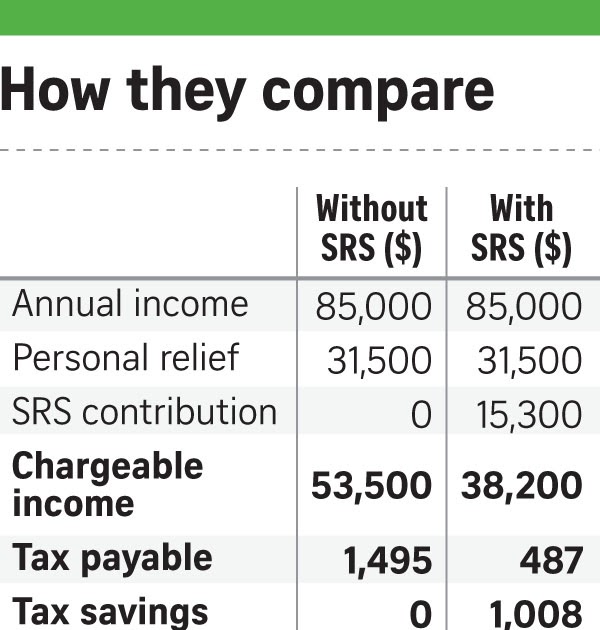
Save 11.5% immediately if are earning >$96,600 per year! Save 7% if you are earning >$51,000

Have you estimated your earned income yet? Have you add in:
- 13month bonus
- Staff discount
- Allowances
Yes, above are some of the income that is earned and taxable.

If you have estimated your earned income to be >$51,000* you can consider putting it to SRS. Cause every dollar set aside will save you 7%.
E.g. If you set aside $1,000 to your SRS, you will save $70 of tax immediately. And if you set aside the SRS maximum of $15,300, you will save $1,071 of tax.

*For simplification, we use $51,000 minus CPF contribution of $10,000 and earned income rebate of $1,000 gives you a chargeable income of $40,000.
Based on IRAS, anything above $40,000 the tax rate is 7% up to $40,000.

If your estimated earning is > $96,600** then every dollar you put aside will save you a whopping 11.5%!
E.g. If you set aside $1,000 to your SRS, you will save $115 of tax.
If you set aside the SRS Maximum amount, you will save $1,756.


This is not every dollar save, every dollar earned.
This is every dollar save, a dollar and twelve cents earned!


Left Image: Get tax relief while building your nest egg
by Lorna Tan on Nov 1, 2015


**Similarly, for simplification, we use $96,600 minus CPF contribution of $15,600 ($6k x 13mth x 20%) and earned income rebate of $1,000 gives you a chargeable income of $80,000.
Based on IRAS, anything above $80,000 the tax rate is 11.5% up to $40,000.

Below is the table for tax savings based on your monthly salary with 10% of your annual income contributed to SRS:

So start saving now! If you have concern on SRS matters such as withdrawal, post your comments below or check with your financial advisor.


12 September 2017

[Case Study]Pay $60k and receive $550 for life - A Good Deal?

Recently we received this case study using premium financing to pay for a retirement plan.

At age 40, with an initial outlay of $60,000, is able to receive a projected monthly income of $550 (for life). How this works:


Can this really works? We are a bit skeptical as it heavily depends on these 2 main conditions and variables:

1) Non-Guaranteed portion
Guaranteed amount is $275 and the loan amount is $311. So the non-guaranteed portion needs to generate minimally $36 to offset the loan totally.
Only if the insurer able to generate 4.75% return on their participating funds, then one can get the $239 extra.

2) Interest Rate
RHB interest is based on 1.8%. Currently we are at all time low interest rate environment. When interest rates go up, the loan amount will go up as well.

To us, though the retirement plan is good but the premium financing part is risky.

1 September 2017

An Important Fundamental of Investing - Rebalancing of Portfolio

Rebalancing of portfolio is one of the fundamentals that an Investor has to carry out with discipline, in order to be successful in investing. 

Let's suppose that you have a $100,000 portfolio, made up of 2 funds at 50% allocation each. The 2 funds are of different asset classes and draws varying performances. So let us imagine this over a period of one year: the first fund, called Fund A, fetches a decent gain of 10%; And the second fund, called Fund B, only manages a return of 1%.

As a result of the above stated performances over a year, Fund A is now worth $55,000 and Fund B is now worth $50,500. The total portfolio gain is $105,500. While I can imagine most Investors would just sit on this portfolio and count on the profit, let us review the allocation weighting after a year: Now, Fund A has a weighting of 52.13%, and fund B has a weighting of 47.87%, of your portfolio (PS: Still remember what was the allocation in the beginning?).


Maybe this may not look too much of a different with how you had started with, at least not for the first year. But can you imagine if your portfolio continues to be managed unprofessionally (ie. poor discipline/awareness in rebalancing) over time, your risk and reward will become somewhat different with what you have intended.


Allow me to illustrate 3 reasons on why you have to rebalance your portfolio at least once, if not, twice a year.
Reason 1:
The first reason is what I have probably stated above. That is, as your portfolio moves, your risk and reward moves. The effect spurning off from the absence of rebalancing a portfolio for a short period of time (e.g. 1 year or less) may somewhat appear insignificant, but the failure to do so for a longer period of time would concomitantly result into a very different portfolio with how you had wanted it to be. By rebalancing the portfolio, you are making adjustment to realign with your original intention in investing into that particular portfolio.

Reason 2:
By rebalancing your portfolio, you are essentially taking profit on the funds that have made you money and putting more money on the underperforming fund (if you still believe in the thesis of investment in the first place). Such an exercise, also allows you to review all the funds that you have in your portfolio.
This is especially essentially as most people harbour a "out of sight, out of mind" mentality when it comes to investing.

Reason 3
If you and/or your advisor is/are diligent enough in rebalancing the portfolio at least once a year, your return on investment would be much smoother than otherwise. It's because each asset class carries different risk profile and return expectation. By doing the above, you are also applying Dollar-Cost-Averaging strategy on the fund that is under-performing.

I hope that you have or would have taken to heart on the above matter (in due time). If you are still not totally convinced or clear with how such an act (rebalancing) could have an effect on your portfolio, please do not hesitate to contact us.