31 July 2017

If there's a catalyst to rekindle your insurability, would you pay for it?

Are we discussing about Science here? Absolutely not. It does not take a degree in rocket science to realise the importance and beauty of having a clean bill of health.

Insurance is an intangible commodity. 
Insurability is a priceless asset, it is non-transferrable & the loss of which, is arguably, irreversible.

So are we trying to tell a fairy tale here? Absolutely not either! It does not take anyone more than an average IQ to tell you that an immortality pill does not exist in this world, at least not for many more decades (I suppose!).

In our years of assisting clients with their insurance application, the scenario that has drawn our greatest empathy lies beneath a 'Declined' underwriting decision. Ironically, this group of applicants (being declined), whose Insurability is somewhat/somehow challenged by medical condition(s), is probably also the group who desires for, and/or needs insurance coverage.

So is there any way to manoeuvre past the underwriting process in order to be granted acceptance?
Since Aug 2007, a British insurer has provided a "catalyst" to one's insurability by introducing what the industry calls the "Moratorium Underwriting" concept here to its Shield plan (a medisave-approved medical insurance). 

The concept works by doing away with medical declarations when an applicant is eligible to elect Moratorium Underwriting option - that is, he/she is not employed in certain hazardous occupations nor has been rejected/postponed/excluded for any health and/or life insurance before, and not required to pay additional premium for his/her MediShield Life coverage. Given such an underwriting option, an eligible applicant is guaranteed with the issuance of the policy, but any pre-existing medical condition(s) is/are, but predictably, excluded.

This concept has arguably removed the biggest bugbear in insurance application and acted as a probable catalyst to rekindle one's insurability after a stipulated period of time subject to its terms & conditions. Instead of having to declare medical conditions that threaten the approval of an application, it guarantees issuance & allows an applicant of sub-standard health to be covered for medical treatment that are required not out of and/or not related to any pre-existing condition(s). And just like any great deals, where terms & conditions apply, it will also top up the deal with "an-icing-on-the-cake" feature. And in this case, it is the possibility of having a pre-existing condition included after 5 continuous years of coverage from the date of commencement of cover or the date of the last reinstatement or the date of upgrade, whichever is later, under the Policy, the insured person has not, in relation to a pre-existing condition:
- experienced symptoms; 
- sought advice or tests from a Physician, a Specialist or Alternative Medicine Provider (including check-ups for that pre existing condition);
- required and/or received treatment or medication; 
Upon fulfillment of the above status, the Pre-existing condition (other than a list of permanently-excluded conditions, e.g. cancer, heart attack) shall be covered.

I hope that after reading this, you are made aware of an option that could help someone in distress when they are in the quest of medical insurance. Don't hesitate to drop myself or Brian an email to find out more if you think this can help someone. 

CheatSheet : Estate Distribution

Before you start shooting the messenger (or rather your "Will Executor" in this case), when he/she does not follow what you wrote in your Will, first make sure what you wrote is valid.

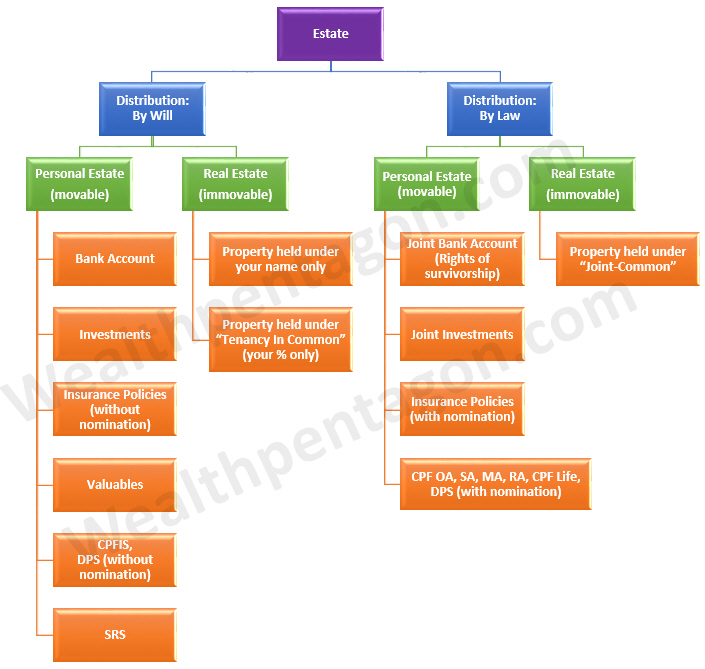
You can easily refer to the cheat sheet below on what can be Will'ed and what can't:


Basically your estate is divided into 2 categories: Those can be distributed by Will and those by Law. Within the categories, each of them is further divided into estate that is movable (like your cash & investment) and those that is immovable (like your properties). All the different estates are listed clearly in their respective categories for your easy reference.

E.g. If you indicate your CPF monies in your Will to be given to so & so, the monies CANNOT be distributed accordingly. Because, by law, CPF monies can only be distributed using the CPF Nomination form.
So have you make your nomination yet? It's free.

[Newsletter]Who will inherit the $3mil?

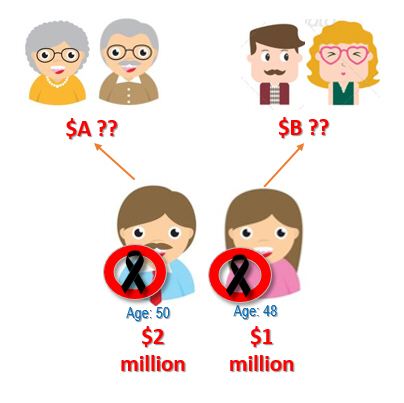
If both the husband and wife met with an accident, without a Will, how would their estate be distributed?
A : Husband's parents
B : Wife's parents

1) A gets $2mil and B gets $1mil
2) A gets $3mil and B gets nothing
3) A gets nothing and B gets $3mil


Tips: Answer can be found in the previous article on "Does everybody have a Will?"


Click here to answer this question and the first 10 correct answers will win a USB Mobile fan (for Android)

30 June 2017

Who needs Insurance Protection more? The Rich or the Poor?

My belief in Insurance, as it has always been since its creation, is in the pooling & transferring of risk. 

I [quote] from wikipedia on the term "Insurance": [Insurance is a form of risk management primarily used to hedge against the risk of a contingent, uncertain loss. Insurance is defined as the equitable transfer of the risk of a loss, from one entity to another, in exchange for payment].

We all have possessions in life, and what accompanies with them is the potential of loss. Murphy's Constant also states that "Matter will be damaged in direct proportion to its value". Hence, we protect and manage our beloved/prized possessions for the fear of losing it. We manage our relationship, for the fear of slipping into a separation. We lock our doors to keep the intruders away from unwanted theft. The fear of losing our possessions stems from the sense of ambiguity. We are just not sure if it would happen. But because of fear, we choose to protect it against potential loss. An example widely used in the insurance industry is the "Spare-tyre" theory. Why do we have with us a spare tyre in our car boot when all the four are still in perfect condition. Yes, you just mouthed it…"JUST IN CASE!". The act of carrying a spare tyre is a classic exhibition of an engineered contingency by transferring any possible risk of a damaged tyre to the spare one!

Regardless of wealth, we all have possessions, tangible and intangible. The need for an equitable transfer of risk of a tangible loss is arguably declining when plotted against a person's accumulation of wealth. A Wealthy car-owner will find it financially manageable to repair/replace his damaged/stolen vehicle. But then again, why has he taken up motor insurance? Does he really find no value in implementing it other than for reason of legislation?

Now, let us study a scenario in an average breadwinner, John, whose wife does not work and stays home to take care of their school-going kid. John strives hard at work to bring food to the table, and expenses on any other items could possibly be deemed as luxury. One day, John is diagnosed with kidney failure and requires periodical admission to the hospital and routine renal dialysis. Do you think medical insurance is a luxury or a necessity for him and his family? On hindsight, with the above scenario painted out in the first place, I would imagine that anyone who is of a sane mind would have advised John to pay for a medical insurance, no matter how meagre his discretionary income is. Now, put yourself through those unwanted scenarios. Have you implemented the applicable insurance coverage that you would have advised John to do?

In my view, a person's insurance need has minimal, if any, correlation to his wealth. No amount of wealth can buy you a crystal ball that tells you what is going to happen next. When one cannot and/or chooses not to live with some forms of uncertainty, they have an option to transfer the risk of a tangible loss via Insurance. And when such an act is duplicated by a large number, it transforms into a phenomenon known as "pooling of risk". Though the risk has been pooled, it is not going to be offered to you for free. It comes at a cost or what we called premium. Then it is down to any willing individual to work out and allocate a budget for this purpose.


This writing here is by no means an attempt to debate on the subject. Rather, we like to urge you to review the priorities in your Insurance Protection needs. That is, which type of Insurance do you need more. If you are unsure, do not hesitate to review this with your trusted adviser!


Does everybody have a Will?

As a matter of fact, yes we do. Even we have not visited any lawyer nor wrote anything before. The Will is actually a default Will decided by the government.

Let's talk about what happen the morning "After" death. If there's a Will in place, the person will die testate. If there's no will then the person dies intestate.

If the person dies testate (with a Will), the "appointed" representative (executor) will go to the court and go through the Probate Process and distribute the estate according to the Will.

If the person dies intestate (without a Will), the "agreed" representative will have to go to the court and go through the Administration Process and the distribution will based on the Intestate Succession Act.

Look and sounds the same? Well, not quite. In fact, there's a big difference. Let's see what's the inconvenience if the person dies intestate (without a Will):

1) "Agreed" Representative
Family members will need to agree on who will be the representative which can cause inconvenience and delays. Upon agreement the representative will be need to apply in the court to be the Administrator.

2) Bond & Sureties
Depending on the court, the Administrator might need to provide a bond and sureties (which each sureties asset worth's is same or more than the deceased) especially when there's minor involves.

3) Intestate Succession Act
The distribution can be found here at point no. 6:
https://www.mlaw.gov.sg/content/pto/en/deceased-cpf-estate-monies/information-for-next-of-kin-estate-monies.html
Generally, if the deceased dies leaving Spouse:
- with no children & parents : 100% Spouse
- with children & no parents : 50% Spouse; 50% Children
- with children & parents : 50% Spouse; 50% Children

It's correct. Parents will not get anything, if the deceased dies leaving spouse with children.

Example, husband and child met with an accident and passed away. The husband estate will go to the child and wife; with no estate for the husband's parents. And when the wife passed away, her estate (including her husband's $2 million) will go to her parents.


Without a Will, you cannot determine how your estate is distributed when you passed on and it can end up with the person you dislike.

So will you make a Will?

[Newsletter]Which estate cannot be distributed by Will?

Which estate cannot be distributed by Will?
The answer is CPF-OA (Ordinary Account)

25 June 2017

Dependants’ Protection Scheme (DPS) looks expensive after 40

On The Sunday Times, well-known Invest Editor, Lorna Tan, wrote an article on DPS with the title "What you need to know about DPS coverage".

Similar to the article we wrote previously below (23Feb2017), it also shows that DPS is more expensive:
If DPS is kept throughout your working years from age 25 till 60, the total premiums work out to be $4,180, significantly higher than those for iTerm which would be about $1,717 for a woman and $2,268 for a man.
Providend says that DPS policyholders in good health may wish to review alternative plans as they reach 40 to take advantage of the lower premiums.
There's also a table of comparison:


So now you know. Time to take action.


[Published on 23 February 2017]

What is Dependants’ Protection Scheme (DPS)?
DPS is an opt-out term insurance scheme which is automatically extended to eligible CPF members. It provides:
1) a Sum Assured of: $46,000 + $5,000,
2) a Coverage Term up to 60 years old &
3) coverage for Death, Terminal Illness (TI) or Total Permanent Disability (TPD)

DPS Premium Rates:
Age (Last Birthday)Yearly Premium
34 years and below$36
35 – 39 years$48
40 – 44 years$84
45 – 49 years$144
50 – 54 years$228
55 – 59 years$260

From 40 to 59 years, the total premium you will need to pay is $3,580
($84x5 + $144x5 + $228x5 + $260x5).

Now, let's do a simple comparison. Go to CompareFirst website and search for similar products as DPS:
Look under "Term Life Products" with the following options:
- Date of Birth: 1 Jan 1977 (for 20yrs calculation)
- Smoker: No
- Premium Type: Annual
- Coverage Term: 20 years
- Sum Assured: $50,000
- Critical Illness Benefit: No
- Sort Results by: Premium (Lowest - Highest)

You will find that AXA Insurance & NTUC Income are among the cheapest for female at $72/year and Great Eastern Life is the cheapest at for male at $91/year (as of 23Feb2017).
Note: Reducing Sum Assured is different from DPS as the sum assured reduces over time.

So for a coverage term of 20 years, you will only need to pay $1,440 & $1,820 for female male rates respectively, to provide for:
1) a Sum Assured of $50,000,
2) a Coverage Term up to 60 years old &
3) a coverage for Death, Terminal Illness (TI) or Total Permanent Disability (TPD)

The above comparison would result into a total savings of $2,140 (60%) for female and $1,760 (49%) for male, relative to DPS rates!

The only caveat is that you need to utilise Cash instead of CPF monies to purchase the Term Insurance. I would think that so long as $72/year or $6/month does not make significant (if any) impact to your monthly discretionary income, this is a potential form of absolute savings. To add, accumulating your monies with CPF, currently gives you a minimum of 2.5% interest.

From the findings above, DPS does look more expensive after 40 years old.